

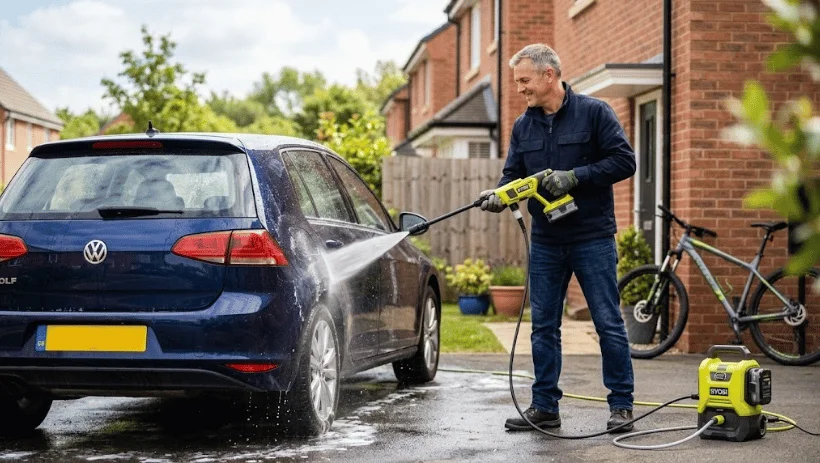
A cordless pressure washer suits UK buyers who value portability more than maximum cleaning power. It can clean cars, bikes, bins, furniture, and muddy gear without a nearby socket. Stronger battery models can tackle light paving work, but large patios still favour mains machines.
This guide compares five current UK options using published specifications, retailer prices, and recent reviewer findings. ReadVanta has not tested these models hands-on, so no performance claim is presented as first-hand experience. Prices were checked in September 2026 and can change with stock, bundles, and promotions.
Quick answer: Choose a handheld model for cars, bikes, camping gear, and quick garden jobs. Pick a tank model when water access is the main problem. Choose a higher-pressure wheeled machine only if you can handle the extra weight, cost, and battery demand.
| Model | Best for | Published pressure | Published flow | Water setup | UK price checked |
|---|---|---|---|---|---|
| Worx WG633E Nitro HydroShot | Best all-round handheld | Up to 56 bar | 220 L/h | Bucket, tank, bottle, or tap | About £144 with 4.0Ah battery |
| Ryobi RY18PWX41A-0 | Best control for cars | 7, 22, or 41 bar | Varies by setting | Bucket, 2L bottle, or tap | £159.99 bare |
| Bosch Fontus 18V | Best built-in tank | 20 bar | Mode dependent | 15L onboard tank | Roughly £185–£251 by seller and bundle |
| STIHL REA 60 PLUS | Best higher-pressure option | 100 bar operating | 240 L/h | Tap or container with suction accessory | £234 tool only |
| Hawksmoor 18V Handheld | Best budget kit | 24 bar | 288 L/h | 6m suction hose and bottle connector | £99.99 with 4.0Ah battery |
Source note: specifications and current UK prices were checked against manufacturer and retailer listings in September 2026.
Key takeaways
- Handheld cleaners are strongest for cars, bikes, bins, furniture, and quick rinses.
- Built-in tanks solve water-access problems but add weight before you start cleaning.
- Battery and charger costs can change the real value of a bare tool.
- Large patios and driveways still favour higher-flow mains machines for repeated cleaning.
Which cordless pressure washer should UK buyers choose?
The Worx WG633E offers the strongest balance for most portable cleaning jobs. Its published 220 L/h flow and 56-bar maximum output suit regular rinsing without a wheeled body. Recent UK comparison guides also place the Nitro HydroShot among the leading handheld choices.
The right choice still depends on where you clean and where your water comes from. A built-in tank can matter more than extra bar pressure beside flats, garages, or shared parking. ReadVanta’s broader pressure washer guide covers stronger mains options for bigger surfaces.
Our five UK picks compared
1. Worx WG633E Nitro HydroShot: best all-round handheld
The Worx combines a compact format with useful flow and a 6m feed hose. Screwfix currently lists a kit with a 4.0Ah battery and a one-hour charge time. It can draw from buckets, tanks, bottles, ponds, or a normal tap.
Pros: Good pressure-to-size balance, flexible water sources, battery included in the checked kit.
Cons: Not intended to replace a mains unit for large patios or deep concrete grime.
2. Ryobi RY18PWX41A-0: best for adjustable car cleaning
Ryobi offers three settings at 7, 22, and 41 bar. The supplied siphon hose can draw from a bucket, while a 2L bottle adaptor improves portability. Ryobi states up to 22 minutes on high using a 5.0Ah battery.
Pros: Three pressure levels, useful car-focused control, wide ONE+ battery compatibility.
Cons: The listed £159.99 price is for the tool only, so new users need a battery and charger.
3. Bosch Fontus 18V: best when you need an onboard tank
The Bosch Fontus carries 15 litres of water inside its wheeled body. Bosch lists 20 bar maximum pressure and up to 60 minutes of battery runtime. Its onboard supply solves access problems, but water capacity usually limits continuous spraying first.
Pros: Built-in water tank, wheels, multiple spray modes, shared POWER FOR ALL battery platform.
Cons: Heavier than handheld choices, and a full tank adds about 15kg of water.
4. STIHL REA 60 PLUS: best for stronger cordless cleaning
The STIHL moves closer to mains-style performance than most handheld cleaners. STIHL lists 100 bar operating pressure, 240 L/h flow, and up to 25 minutes runtime. It also includes a 5m hose reel and variable pressure control.
Pros: Much stronger operating pressure, integrated hose storage, adjustable output.
Cons: At £234 tool-only, the full battery system costs more than compact handheld kits.
5. Hawksmoor 18V Handheld: best budget kit
Toolstation lists the Hawksmoor at £99.99 with a 4.0Ah battery and charger. It has 24 bar maximum pressure, 288 L/h maximum flow, and a 6m hose. Auto Express also rated this model strongly in its 2025 cordless group test.
Pros: Battery included, strong flow for the price, useful accessories in the box.
Cons: Its brushed motor and 24-bar output target lighter work rather than demanding paving jobs.
Are battery models powerful enough for UK cleaning jobs?

For cars, bikes, bins, furniture, and muddy tools, modern battery cleaners can be practical. The main limitation is sustained cleaning speed on large, dirty hard surfaces. Independent UK guides consistently warn that cordless models are not direct substitutes for strong mains machines.
Pressure matters, but flow also affects how quickly loosened dirt leaves the surface. A narrow jet can feel powerful while still covering little area. For broad paving, higher flow and a suitable surface-cleaning setup usually save more time than portability.
Water supply matters more than most buyers expect
A portable cleaner only feels portable when its water setup matches the job. Handheld models commonly use a suction hose from a bucket or container. Tank machines remove that hose, but the water itself becomes extra weight.
A 20-litre bucket lasts about five minutes at a 240 L/h continuous flow rate. At 220 L/h, the same bucket lasts roughly five and a half minutes. Real cleaning lasts longer because users release the trigger between passes.
| Flow rate | 20L water supply at continuous flow | Practical meaning |
|---|---|---|
| 220 L/h | About 5.5 minutes | Fine for short rinsing with pauses |
| 240 L/h | About 5 minutes | Plan extra water for larger jobs |
| 288 L/h | About 4.2 minutes | Higher flow empties buckets faster |
What should you check before buying?
Start with the jobs you clean every month, not the largest number on the box. Cars need controllable spray patterns, while bikes benefit from easy handling and quick setup. Large patios need longer runtime, more flow, and more sustained power.
- Battery platform: A bare tool can be good value if you already own compatible batteries.
- Water source: Check whether the machine self-primes from a bucket or needs an accessory.
- Flow rate: More flow can rinse loosened dirt faster, but it empties portable water sooner.
- Pressure control: Lower settings help around paint, trim, seals, and softer materials.
- Weight: Include the battery, hose, accessories, and carried water in your real setup.
- Spare parts: Check filters, hoses, nozzles, batteries, and connectors before choosing a platform.
For decking, avoid treating maximum pressure as the default setting. Aggressive cleaning can damage older coatings, soft timber, and weak surfaces. ReadVanta’s decking paint guide explains preparation before refinishing outdoor timber.
Cordless versus mains: which type makes more sense?
Choose cordless when sockets, extension leads, or outdoor taps create more trouble than the dirt itself. Choose mains when you regularly clean large patios, long drives, or heavily soiled paving. The cheaper machine can become the worse buy if it doubles your cleaning time.
Battery compatibility can also change the value calculation. Owners already using Ryobi ONE+, STIHL AK, or Bosch POWER FOR ALL may avoid duplicate chargers. New buyers should compare the complete kit price, not the bare-tool headline.
Safe use around cars, glass, and garden surfaces
Start with a wider spray and more distance when cleaning delicate surfaces. Avoid rotary nozzles on vehicle paint, seals, badges, and fragile trim. Follow the vehicle and equipment instructions before increasing pressure.
High-pressure cleaning is also a poor substitute for proper window tools. ReadVanta’s window cleaning kit guide, which covers squeegees, poles, and safer glass-cleaning choices. For wider household projects, browse the Home Improvement guides.
Buying verdict
The Worx WG633E is the strongest all-round starting point for portable UK cleaning. Choose Ryobi when adjustable handheld control matters most, especially around vehicles. Pick Bosch when carrying your own water matters more than maximum pressure.
The STIHL REA 60 PLUS makes more sense when stronger output justifies a larger investment. Hawksmoor offers a lower-cost kit that includes the battery. Compare the full battery bundle, water setup, and regular jobs before ordering.
Next, list your usual cleaning jobs and the nearest usable water source. Then check whether you already own a compatible battery platform. Compare the complete kit price before buying, including batteries, chargers, hoses, and missing accessories.
Frequently asked questions
Is a cordless pressure washer worth buying?
Yes, when portability solves a real access problem around your home, car, or outdoor hobbies. These machines work well for frequent light cleaning and quick rinses. A mains unit remains the better choice for repeated heavy patio or driveway work.
Can a battery cleaner draw water from a bucket?
Many handheld models can self-prime through a filtered suction hose placed in a bucket. Worx and Ryobi both support portable water sources on the models covered here. Always check the supplied accessories because some machines need separate suction parts.
How much pressure do I need for a car?
Control matters more than chasing the highest bar figure for vehicle washing. Use a wide fan, sensible distance, and a lower setting where available. Avoid concentrated rotary jets on paint, trim, seals, and badges.
Can cordless models clean patios?
They can rinse small paved areas and remove light surface dirt with suitable nozzles. Thick algae, large driveways, and stubborn grime take longer with most battery models. A stronger mains machine usually suits repeated hard-surface cleaning better.
How long does the battery last?
Runtime depends on battery capacity, pressure setting, motor efficiency, and trigger use. Ryobi states up to 22 minutes on high with a 5.0Ah battery. STIHL states up to 25 minutes with its recommended AK 30 S battery.

