

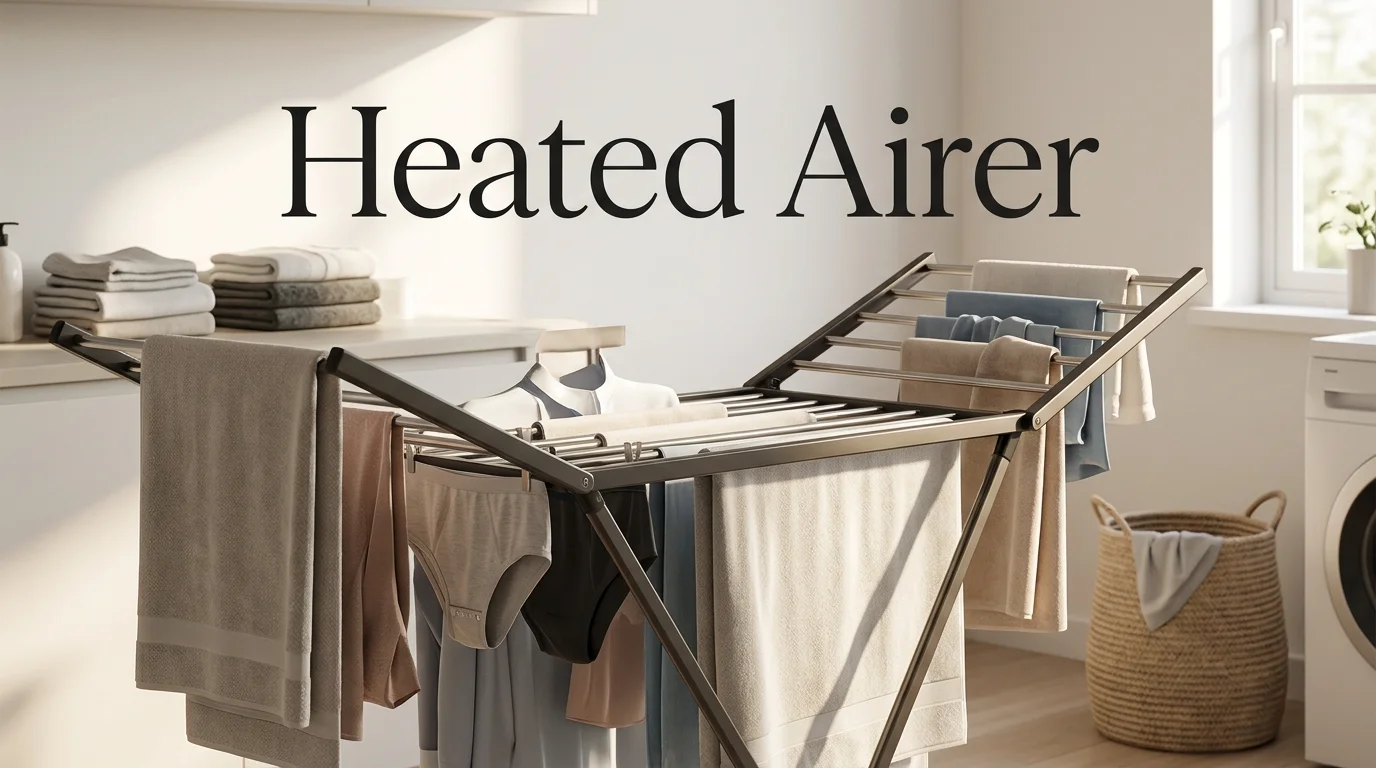
A heated airer can make indoor laundry easier during wet UK weather. It warms clothes more gently than many tumble dryers and usually draws less power. The right model depends on your space, load size, drying speed, and ventilation.
| Key point | What UK buyers should know |
|---|---|
| Main types | Heated-rail racks, three-tier towers, winged racks, and warm-air drying pods |
| Typical power | Heated-wire models are often about 250–330W; store-bought pods are often about 800–1,000W |
| Current electricity rate | Ofgem’s average Direct Debit rate is 26.11p/kWh through 30 September 2026 |
| From 1 October 2026 | Ofgem’s average Direct Debit rate rises to 26.32p/kWh |
| Typical drying time | Many rail models need several hours; drying speed varies with fabric, spacing, room temperature, and airflow |
| Main buying checks | Capacity, folded size, timer, cover, wattage, stability, cable length, and safety instructions |
| Moisture control | Ventilate the room or use a dehumidifier to reduce condensation risk |
Direct answer: A heated airer is a plug-in clothes rack that warms its rails or circulates warm air around laundry. Rail models usually use less power than fan-driven pods. For most UK homes, the best choice balances drying space, storage, running cost, ventilation, and the speed you actually need.
Which Type Should You Choose?
UK buyers will usually see three main designs. Heated-rail towers offer lots of hanging space in a small footprint. Winged racks are simple to load, while drying pods use moving warm air for quicker results.
| Type | Typical power | Main strength | Main drawback | Best suited to |
|---|---|---|---|---|
| Three-tier heated rail | Around 250–330W | High capacity for the floor space | Can be bulky when open | Families and frequent laundry |
| Winged heated rail | Often around 200–300W | Easy loading and flatter storage | Less compact while in use | Couples, smaller loads, towels |
| Heated drying pod | Commonly around 800–1,000W in shops | Faster drying and enclosed airflow | Higher hourly cost and fan noise | Small homes needing speed |
Three-Tier Heated Rails
Three-tier racks suit households that wash several loads each week. Their vertical design gives plenty of rail length without using excessive floor space. A fitted cover can help retain warmth around the clothes.
Pros
- Good capacity for families
- Efficient use of floor space
- Often available with timers and covers
Cons
- Large when fully opened
- Thick items can block airflow
- Usually slower than a pod
Winged Heated Rails
Winged models resemble a traditional clothes horse with heated bars. They are easy to understand and usually fold quite flat for storage. Larger garments can also lie across the wider sections.
Pros
- Straightforward loading
- Often cheaper than premium tower models
- Convenient for jumpers, trousers, and towels
Cons
- Uses more horizontal floor space
- Capacity varies widely
- Clothes still need good spacing
Heated Drying Pods
Pods circulate warm air inside a fabric enclosure. Electrical Safety First says store-bought models commonly draw around 800–1,000W. That higher power can shorten drying time, but it raises hourly electricity use.
Pros
- Faster drying than many heated-rail racks
- Enclosed airflow surrounds hanging clothes
- Useful where turnaround time matters
Cons
- Higher power use
- Fan noise may be noticeable
- Lower practical capacity for bulky laundry
How Much Does a Heated Airer Cost to Run in the UK?
Ofgem’s average electricity rate is 26.11p/kWh through 30 September 2026. It rises to 26.32p/kWh from 1 October through 31 December 2026. Your tariff can differ by region, payment method, and contract.
| Appliance rating | Cost per hour at 26.11p/kWh | Cost per hour at 26.32p/kWh |
|---|---|---|
| 250W rail rack | about 6.5p | about 6.6p |
| 300W rail rack | about 7.8p | about 7.9p |
| 330W rail rack | about 8.6p | about 8.7p |
| 800W drying pod | about 20.9p | about 21.1p |
| 1,000W drying pod | about 26.1p | about 26.3p |
These figures show hourly electricity use, not the cost of fully drying one load. A lower-powered rack can run much longer than a faster pod. Compare total drying time and the wattage on the label.
Which? reports that the heated clothes airers it tested varied greatly in drying speed and hourly cost. Its 2026 testing found some heated racks could take several hours for a cotton load. That makes loading technique and room conditions important parts of real-world cost.
Are Heated Clothes Airers Cheaper Than Tumble Dryers?
A heated rail usually has a much lower power rating than a conventional tumble dryer. That does not guarantee the lowest cost for every load, because drying times can be much longer. Modern heat-pump dryers can also be far more efficient than older vented or condenser machines.
For households without a tumble dryer, a heated rack can be a practical middle ground. It speeds drying compared with an unheated rack without needing a high-powered dryer. If you already own an efficient heat-pump dryer, compare energy per completed load before assuming the rack is cheaper.
Readvanta’s electric-heater guide explains the same basic energy rule for household appliances. Multiply power in kilowatts by hours, then by your electricity rate, to get the energy cost. That calculation is more useful than relying on broad claims about low running costs.
Will Indoor Drying Cause Condensation or Damp?
Wet laundry releases moisture into the room whether the rack is heated or not. Energy Saving Trust recommends extra ventilation when clothes are drying indoors. Opening windows briefly or using extraction can reduce trapped moisture.
A dehumidifier can also help control humidity while laundry dries. Readvanta’s guide to ElectriQ dehumidifiers covers extraction capacity, laundry modes, and room suitability. This can be useful in homes that regularly struggle with condensation.
Keep the rack away from walls if the manufacturer allows it. Leave space between garments so warm air can move around them. Crowding clothes tightly together slows drying and can leave thicker areas damp.
What Features Are Worth Paying For?
Capacity matters more than a long feature list. Check the maximum load, usable rail length, and whether shelves move for larger items. Also measure the space where the rack will stand and where you’ll store it.
A timer is useful if the appliance often runs for several hours. A compatible cover can reduce heat loss around the laundry, but it must be designed for the product. Never improvise with materials that block ventilation or conflict with the instructions.
Stability also deserves attention, especially in busy family homes. Check how solid the frame feels when loaded and whether the feet grip the floor. Cable length matters too, because the appliance should reach a suitable socket safely.
How to Dry Clothes Faster on a Heated Rack
Good loading technique can make more difference than choosing the highest wattage. Run an extra spin cycle when the fabric allows it, because less retained water means less drying time. Then spread garments across the rails instead of layering them.
- Leave gaps between thick garments.
- Place heavier items where heat and airflow are strongest.
- Turn or reposition slow-drying items midway through the cycle.
- Use a fitted cover only if the manufacturer supports one.
- Ventilate the room while the laundry dries.
- Remove dry items early to free space around damp ones.
Room temperature also affects performance. A cold, closed room usually slows evaporation and raises humidity. If the room itself needs warming, Readvanta’s electric-heater guide explains suitable heater types and running costs.
Safety Checks Before Use

Treat any electric drying appliance as a heat-producing device. Check the plug, cable, frame, and controls before use, and stop using damaged equipment. Follow the manufacturer’s load limits and placement guidance.
Avoid cheap extension leads and overloaded sockets. Keep the appliance clear of curtains, soft furnishings, and other materials that could restrict airflow. Electrical Safety First also recommends watching for hot plugs, damaged sockets, buzzing, or repeated breaker trips.
Most manufacturers advise caution when using them unattended. Which? says it is safer to avoid leaving these appliances running while you sleep or when nobody is home. Always follow your model’s manual.
Our Recommendation for Most UK Homes
For most households, a three-tier heated-rail model offers the best balance of capacity, power use, and floor space. A timer and compatible cover are useful extras if the room has good ventilation. Choose a pod instead when faster turnaround matters more than the lowest hourly cost.
Small households may prefer a winged rack because it stores easily and suits lighter loads. Families should prioritise rail length, stability, and flexible shelves. Homes with condensation problems should also plan moisture control before relying on indoor drying throughout winter.
Readvanta’s Home Improvement section has more practical guides for heating, moisture control, and household equipment. Those topics often overlap during colder months. Planning them together can make a utility room or spare room work more effectively.
Frequently Asked Questions
Is a Heated Airer Cheaper to Run Than a Tumble Dryer?
A heated rail usually draws much less power per hour than a conventional dryer. It can also take much longer to finish a load. Compare total kilowatt-hours per load for the fairest cost comparison.
How Long Do Heated Clothes Airers Take to Dry Clothes?
Drying time varies with fabric thickness, room temperature, airflow, and loading. Which? testing found many heated racks needed several hours for cotton loads. Smaller items usually dry sooner than jeans, towels, or bedding.
Can You Leave a Heated Clothes Airer on Overnight?
Check the product manual before leaving any model unattended. Most brands advise against running them while you sleep or when nobody is home. Timers and automatic shut-off features can reduce unnecessary running.
Do Heated Clothes Airers Cause Damp?
The appliance does not create water, but wet clothes release moisture into the room. Poor ventilation can allow that moisture to condense on cold surfaces. Ventilation or a dehumidifier can reduce the risk.
Are Drying Pods Better Than Heated Rails?
Pods are usually faster because they move warm air around hanging clothes. They also tend to use more electricity each hour and may produce fan noise. Rail models suit buyers who value capacity, quiet operation, and lower power demand.
Final Buying Checklist
Start with your normal laundry load, not the biggest model on sale. Measure the available floor space, storage space, and distance to a suitable socket. Then compare wattage, capacity, timer controls, cover options, warranty, and safety instructions.
Use the hourly cost formula before buying. A 300W rack costs about 7.8p per hour at the current September 2026 average capped electricity rate. From 1 October, the same calculation is about 7.9p per hour.
The best purchase is the model that fits your laundry routine and room. Faster drying, sensible power use, safe operation, and good moisture control matter more than headline claims. Choose the format that solves those needs without paying for unused capacity.

