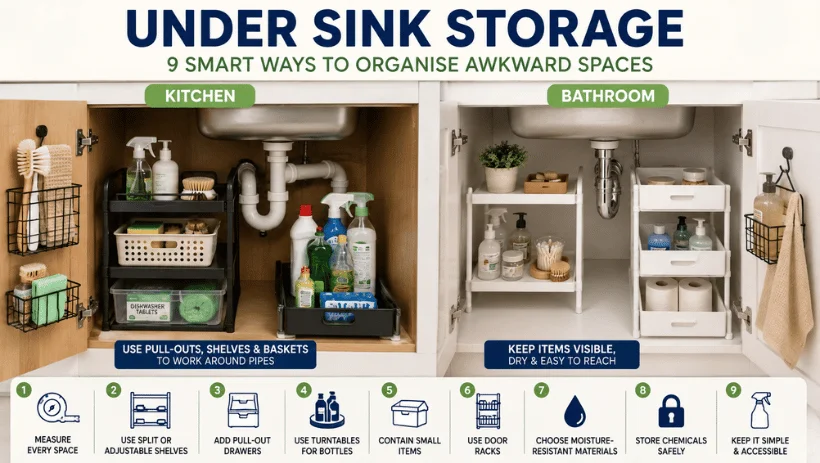
Good under sink storage can turn one of the most awkward cupboards in your home into a useful, easy-to-reach space. The trick is choosing organizers that work around waste pipes, valves, and the sink bowl instead of fighting them. A practical setup also keeps frequently used products visible while leaving plumbing accessible for checks or repairs.
Quick answer: The best setup uses adjustable or split-level organizers that fit around pipes, keep everyday items visible, and leave valves accessible. Measure the cupboard before buying, use pull-out drawers for deep spaces, choose moisture-resistant materials, and keep hazardous cleaning products locked away or out of children’s reach.
| Under Sink Storage | Practical choice |
| Awkward central pipework | Split shelves or two narrow organizers |
| Deep cupboard | Pull-out drawers or removable caddies |
| Limited height | Low baskets or shallow sliding trays |
| Small bathroom | Freestanding basin unit or narrow shelving |
| Damp-prone cupboard | Plastic, coated metal or washable containers |
| Rented home | Freestanding or adhesive solutions |
| Children in the home | Locked or high-level chemical storage |
| Typical UK budget | Roughly £9–£22 for simple organizers; more for cabinets |
| Best first step | Measure every clear section before buying. |
Current UK listings show how wide the price range can be. IKEA lists a simple UPPDATERA slider at £9, Argos has basic bathroom units around £22, and The Range lists some pull-out organizers for about £15.99. Larger enclosed cabinets can cost considerably more, so buying according to the cupboard shape usually makes more sense than choosing by appearance alone.
Why the Space Under Sink Storage Is Difficult to Organize
A normal cupboard gives you a rectangular storage area, but the cupboard beneath a basin rarely does. Waste traps, water pipes, valves and the bottom of the sink remove usable height and divide the space into irregular sections. Deep cabinets also make bottles at the back difficult to see or reach.
This is why standard shelves can waste more room than they save. IKEA’s UK organisation guidance recommends flexible containers, extra levels and pull-out solutions that can work around plumbing rather than blocking it. It also suggests boxes, tiered shelving, door storage and cleaning caddies for kitchen cupboards.
The important point is to organize the usable space rather than the total cupboard dimensions. A 60 cm-wide cabinet may have much less uninterrupted width once its waste pipe is considered. Measuring each clear zone gives you a much better chance of buying something that fits.
Which Under-Sink Storage Type Should You Choose?
No single organizer suits every kitchen or bathroom. Your best option depends on pipe position, cabinet depth, the products you store, and whether you can drill into the cupboard. The comparison below shows where the main designs work well.
| Organizer type | Best for | Pros | Cons |
| Adjustable shelf | Irregular pipe layouts | Flexible, inexpensive, and uses vertical space | Can be awkward around low traps |
| Pull-out drawer | Deep cupboards | Excellent access to the back | Needs enough clear depth |
| Stackable boxes | Small loose items | Cheap, removable, easy to group | Lower boxes can be inconvenient. |
| Turntable | Bottles and sprays | Easy access without reaching behind | Wastes some corner space |
| Door rack | Gloves, clothes, and small items | Uses otherwise space | Must clear shelves and pipework |
| Freestanding basin unit | Bathrooms without a cabinet | Adds concealed or open storage | Requires accurate basin measurements |
Our recommendation: start with removable containers or a pull-out organizer unless your cabinet has an unusually complicated pipe layout. These choices make it easier to change the arrangement later and give you access to the cupboard base. Adjustable shelving is the better choice where plumbing divides the cabinet into several narrow areas.
Measure Before You Buy Anything
A few minutes with a tape measure can prevent most failed purchases. Measure the internal width, height, and depth first, then record the position of pipes, valves, and hinges. You should also measure the lowest point of the sink bowl because product dimensions often assume a fully rectangular space.
Use this simple five-step check:
- Measure the internal width between the cabinet sides.
- Measure the usable depth from the back panel to the closed door.
- Record the lowest available height beneath the basin.
- Mark the waste trap, supply pipes and shut-off valves.
- Check that doors, hinges and existing bins can still move freely.
Sketching the cupboard on paper can make product comparisons much easier. Divide the sketch into clear zones on the left, right and below the pipework. You can then compare those measurements directly with retailer specifications.
9 Practical Ideas That Work Around Pipework
A useful arrangement does not need to fill every centimeter. Leaving some clear space makes leaks easier to spot and gives you access to valves when required. The following ideas can be mixed according to the shape of your cupboard.
- Use two narrow organizers instead of one wide shelf. Position one on each side of a central waste trap.
- Add a pull-out basket at the front. Daily cleaning products stay accessible without moving everything else.
- Use a turntable for bottles. Rotating storage works well where several sprays or toiletries share one corner.
- Place shallow containers beneath low pipes. Sponges, cloths and bin bags need little vertical clearance.
- Use clear boxes for smaller items. You can identify the contents without lifting every container.
- Hang lightweight items inside the door. Gloves, brushes and cloths can use space that would otherwise remain empty.
- Group products by task. Keep washing-up items, surface cleaners and spare supplies in separate zones.
- Use a removable cleaning caddy. You can carry several everyday products around the home without searching through the cabinet.
- Protect the cabinet base. A washable liner or tray can make minor drips easier to notice and clean.
The strongest layouts usually combine only two or three of these ideas. Too many containers can create another layer of clutter and make plumbing difficult to reach. Keep the items you use most near the front and move occasional supplies elsewhere.
Kitchen and Bathroom Setups Need Different Priorities
Kitchen cupboards often hold washing-up liquid, dishwasher supplies, refuse bags and cleaning products. They may also contain recycling bins, which leaves less space for shelves and drawers. A modular system that can move around waste pipes and bins is usually the most practical approach.
Bathroom storage often contains smaller toiletries, toilet rolls, towels and grooming products. Freestanding units designed to surround a pedestal basin can work where there is no existing vanity cabinet. Current Argos designs, for example, include open steel units and enclosed furniture intended to fit around bathroom plumbing.
Avoid using a damp or warm kitchen sink cupboard for food unless the storage conditions are suitable. This specifically advises that the area can be poor for food because heat and moisture may encourage mold or bacterial growth. Use normal kitchen cupboards or other dry food-storage areas instead.
Make Deep Cupboards Easier to Reach
Depth looks useful on paper, but it often creates hidden clutter. Bottles gradually move behind one another until items at the back become forgotten. Pull-outs solve this problem by bringing the stored contents towards you.
You do not always need fitted runners or an expensive cabinet system. A handled basket can act as a simple manual pull-out, while a narrow caddy lets you remove a complete group of products together. Removable systems are particularly useful in rented properties because they require little or no permanent alteration.
Before buying a sliding unit, check both depth and vertical clearance. Some two-tier products fit the cabinet footprint but collide with the sink bowl or trap as they move. Product dimensions need to be compared with your usable space, not merely the cabinet’s advertised size.
Keep Moisture and Leaks in Mind
The cupboard beneath a sink should be easy to inspect. Avoid packing products tightly around joints or valves because a small drip can otherwise remain unnoticed. A washable tray or cabinet liner can also help protect the base from minor spills.
If you repeatedly find condensation, musty smells, or dampness beyond the immediate plumbing area, investigate the source rather than hiding it with storage boxes. Readvanta’s ElectriQ dehumidifier guide covers household moisture control and factors to consider when humidity is affecting a wider room. A plumbing leak itself still needs to be repaired rather than treated as a humidity problem.
Plastic containers and coated metal racks are usually easier to wipe after a spill than untreated absorbent materials. Whatever material you choose, remove the organizers occasionally and inspect the cabinet base. Regular access is one reason removable systems often work so well beneath sinks.
Store Cleaning Products Safely
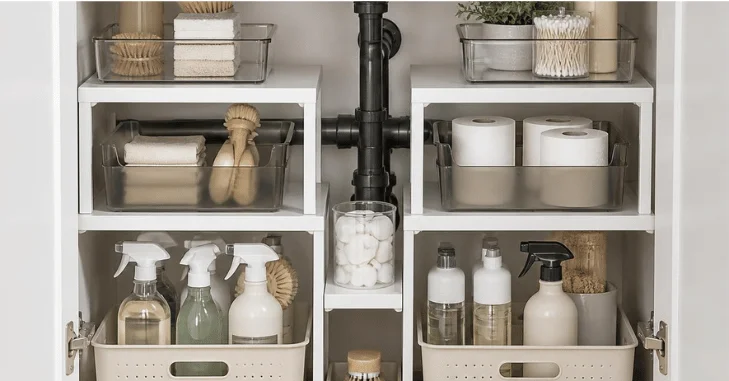
Convenient organization should never make hazardous products easier for children to access. RoSPA advises keeping household chemicals in their original packaging and storing them out of children’s sight and reach, ideally high up or in a locked cupboard. The NHS also recommends safety catches on low cupboards containing harmful products.
Do not pour bleach, detergents or other cleaners into decorative, unlabelled bottles to make the cupboard look tidier. Original packaging carries hazard information and may include child-resistant closures. RoSPA also warns that transferring chemicals into food or drink containers can increase the risk of accidental poisoning.
If you have young children, the safest answer may be to store cleaning chemicals somewhere else entirely. The space beneath the sink can then hold cloths, brushes, refuse bags or other lower-risk supplies. Organizations should support safe household habits rather than override them.
How Much Should You Spend in the UK?
You can improve a basic cupboard without buying fitted furniture. Current UK examples include simple sliding or freestanding organizers around the £9–£22 level, while larger bathroom cabinets commonly move into roughly the £35–£100 range. More substantial vanity furniture can cost hundreds of pounds.
A low-cost organizer is often enough if the existing cupboard itself is sound. Spend more when you need strong runners, an enclosed bathroom cabinet, adjustable fittings or a finish that will remain visible in the room. Always check current retailer prices because promotions and availability change.
Do not assume the most expensive system will use the space best. A £15 pull-out that fits beside your pipes can be more useful than a large cabinet insert that blocks a valve. Fit, access and ease of cleaning matter more than the number of shelves.
Common Mistakes to Avoid
Buying before measuring is the most common practical error. Another is filling the cupboard so completely that you cannot see the pipework or retrieve items at the back. Large matching boxes may look neat but can waste space if they do not fit around the plumbing.
Door organizers can also cause problems if their contents hit an internal shelf as the cabinet closes. Check the door swing with a temporary cardboard template before fitting anything permanently. Adhesive accessories should also be suitable for the surface and expected load.
The final mistake is keeping too many backup products beneath the basin. One open bottle of each everyday cleaner may be enough, while bulk refills can live in another safe cupboard. Reducing the contents often creates as much usable room as adding another organizer.
The Best Setup for Most UK Homes
For a typical kitchen cabinet, a practical combination is one pull-out basket, one narrow box beside the waste pipe, and a small door-mounted holder. This arrangement gives you quick access while leaving some of the cabinet floor visible. It can also be changed without rebuilding the cupboard.
For a bathroom, choose between internal organizers and a purpose-built basin unit according to whether you already have a vanity cabinet. Open designs suit frequently used towels and toiletries, while enclosed furniture hides visual clutter. Always compare the basin cut-out and plumbing position with the product dimensions before ordering.
Readvanta’s Home Improvement guides cover more DIY, home organization, and household projects of this kind, and Detached House collects further practical advice on improving living spaces.
Frequently Asked Questions
Start by removing everything and measuring the clear areas around the plumbing. Use narrow, adjustable, or pull-out organizers rather than one large shelf that blocks the waste trap. Keep frequently used items near the front and leave valves accessible.
They are useful in deep cupboards where items at the back are difficult to reach. A sliding drawer brings the contents towards you and reduces the need to remove several bottles first. Check the height and pipe position carefully because some two-tier designs need more clearance than expected.
Cleaning cloths, washing-up supplies, refuse bags and low-risk household accessories are common choices. Hazardous chemicals need extra care, particularly in homes with children, and may be safer in a locked or high cupboard. Food is usually better stored somewhere dry and away from possible heat, leaks, and cleaning chemicals.
Use freestanding shelves, handled baskets, stackable containers, or suitable adhesive hooks. These options can be removed easily and work well for renters or anyone who wants a flexible arrangement. Check the load limit before using adhesive storage for bottles or other heavy items.
Both can work well if they are moisture-resistant and easy to clean. Plastic is lightweight and usually inexpensive, while coated metal can provide a stronger frame for sliding or tiered designs. Choose according to the available dimensions and the weight of the products you plan to store.